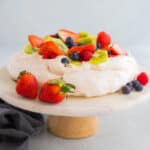
Classic Pavlova
Experience the perfect balance of crispy and fluffy texture with this Classic Pavlova. With a crunchy crust and a soft, marshmallow-like center, it's a simple yet beautiful dessert that is perfect for any holiday or occasion!
Servings 8 servings
Calories 110kcal
Ingredients
- 4 egg whites
- 1 cup granulated sugar
- 1 teaspoon pure vanilla extract
- ½ teaspoon cream of tartar or 1 teaspoon lemon juice or vinegar
- 1 tablespoon cornstarch
Instructions
- Preheat the oven to 350F. Line a baking sheet with parchment paper (draw a 7-8 inch circle on the paper.)
- Using a hand mixer or stand mixer fitted with a whisk attachment, beat the egg whites and vanilla extract on medium speed until soft peaks form (the peak slowly collapses on itself.)
- Add in the sugar, half a cup at a time, and continue beating until glossy, stiff peaks form and the sugar is dissolved (it should no longer feel gritty.) The peaks should be very stiff at this point. If not, continue mixing at high speed until they have reached a stiff consistency (when the beaters or whisk are lifted up, the peak doesn’t move.)
- Use a spatula to scrape the bowl and gently fold in the cream of tartar and cornstarch. Fold until all of the powder is absorbed, taking care not to overfold the meringue.
- Transfer the meringue to the prepared baking sheet. Use a spatula to create tall edges and a slight depression in the middle.
- Place the pavlova in the oven and immediately reduce the heat to 200F. Bake for 90 minutes or until the pavlova is firm and dry to the touch; it will turn a slight cream color.
- Turn the oven off and let the pavlova cool inside the oven. Allow it to cool for at least 5-6 hours or overnight, which will help prevent it from cracking (although some cracking is normal.)
- Just before serving, top with whipped cream and fresh fruit.
Notes
**Nutrition facts have been calculated without the addition of any toppings.**
- Storage Instructions: If the pavlova has toppings, it must be enjoyed immediately as it starts to lose it's crisp texture after 20-30 minutes. If it is un-topped, you can store it in an airtight container at room temperature for up to 2 days.
- Don't Make on a Humid Day: Meringue is full of sugar, so if the humidity is high when you make pavlova it will absorb moisture in the air. This will make the meringue weep or it will go soft and sticky after baking.
- Avoid Oil or Egg Yolks: Traces of fat or oil on the bowl or beaters, as well as bits of egg yolk, can prevent how well your egg whites whip.
- Cracked Pavlova: It is normal for pavlova to crack or collapse slightly. But if the pavlova is collapsing too much this can be caused by over-beaten egg whites, baking in a too hot oven and cooling too quickly, and weeping (which happens when you bake on a humid day.) You can still eat it if this happens, it just won't be as pretty!
- Garnish Before Serving: Store the pavlova, un-topped in an airtight container until ready to serve. Anything moist dissolves the meringue, like whipped cream or fresh fruits. Then, just before serving, add the toppings.
Nutrition
Calories: 110kcal | Carbohydrates: 26g | Protein: 2g | Fat: 0.1g | Sodium: 25mg | Potassium: 57mg | Fiber: 0.01g | Sugar: 25g | Calcium: 1mg | Iron: 0.04mg
